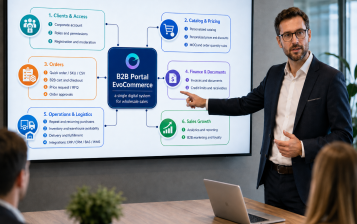

Many wholesale companies believe that they have already automated sales, because they actively use Viber, Telegram, Excel spreadsheets, PDF price lists, product images, and customer newsletters. At first glance, this may indeed look convenient. The manager quickly sent a price list, the customer reviewed the file, wrote a response, checked availability, received a price, and agreed on the order.
But in practice, this model only works as long as there are few customers, orders are simple, and managers have time to control everything manually. When a company wants to actively attract new wholesale buyers, scale sales, work with dealers, stores, distributors or partners, the old ways start to create more problems than benefits.
This is especially noticeable at the stage of first contact with a new client.
Why the old way doesn't work well enough anymore
Let's imagine a situation. A potential wholesale client saw a company's advertisement, went to a website or page on a social network, became interested in the products, and wants to understand whether it is worth working with this company.
Instead of convenient access to the catalog, prices, terms of cooperation, and the ability to quickly form a request, he often receives a response from the manager: “Write to us on Viber”, “Let's drop the price list on Telegram”, “Here is a PDF file”, “Here is an Excel spreadsheet with products”.
For the company itself, this may seem like a normal process. But for a new client, it is not always convenient. He needs to open files, search for the necessary items, clarify balances, wait for the manager's response, check prices, ask additional questions, and manually form an order.
As a result, some potential buyers simply don't make the purchase. Not because the product is bad. And not because the price isn't right. But because the path to purchase is too complicated.
Viber and Telegram are communication channels, but not a sales system
Messengers are good for quick communication. They can clarify details, answer questions, and maintain contact with the client. But Viber or Telegram cannot fully replace a B2B portal.
In messengers, it is difficult to systematically display the entire assortment, personal prices, balances, product characteristics, delivery terms, order history, payment statuses, documents, and special offers.
When sales are built only through correspondence, the business is heavily dependent on the manager. If the manager does not respond in time, forgets to send an updated price list, mixes up the file, or does not see the message, the customer may lose interest or go to a competitor.
Wholesale automation doesn't start when a company creates a Viber group. It starts when a customer can log into a convenient digital account, see the information they need, and place an order without any hassle.
A PDF price list and an Excel spreadsheet do not replace a modern catalog.
PDFs and Excel can be useful as supporting tools, but they don't create a complete buying experience for the customer.
It is difficult to quickly find the desired product in a file, compare options, see current balances, view photos, specifications, related products or special conditions. It is even more difficult to work with a large assortment, when there are hundreds or thousands of products.
In addition, files quickly become outdated. Prices have changed, stock levels have been updated, some products have disappeared, new items have appeared — and the manager needs to send out an updated price list again. A client may accidentally use an old file, place orders at outdated prices, or request products that are no longer in stock.
A B2B portal solves this problem. The client sees the current catalog, updated prices, availability of goods, specifications, photos, descriptions and conditions specifically for their group of buyers.
A new client wants to quickly understand whether it is worth working with you.
For a new wholesale buyer, the first impression is of great importance. If a company invites to cooperate, launches advertising, promotes products and wants to attract new partners, it must provide the client with a simple and clear way to get acquainted with the assortment.
The best scenario looks like this: the client moves from advertising to the site, registers on the B2B portal, receives guest or limited access, browses the catalog, gets acquainted with the prices, conditions, and characteristics of the products, and can immediately place the first order or request an individual offer.
This is much more convenient than waiting for the manager to send the file or manually select the goods.
A B2B portal allows the client to independently study the company's offer at a time convenient for him. He does not feel pressure, does not get lost in correspondence and does not waste time searching for the necessary information in dozens of files.
B2B portal makes the sales process clear for the customer
When a client enters their personal account on a B2B portal, they see not a chaotic set of messages, but a structured system.
He can browse product categories, find the items he needs, read the specifications, see his prices, add products to the cart, place an order, ask a question to the manager, or receive a special offer.
For the client, it looks professional. He sees that the company works systematically, values his time, and is ready for normal long-term cooperation.
It is also convenient for the seller. The manager does not waste time on constantly sending files, clarifying basic questions and manually forming each order. He can work with the client more efficiently: advise, offer better conditions, help with the choice, develop partnership relations.
Guest access is a convenient way to attract new wholesale customers
Not every new client is ready to place an order right away. First, they want to look at the assortment, evaluate prices, understand the conditions, and compare the offer with competitors.
This is where guest or preview access to the B2B portal comes in handy. A company can allow a potential client to view part of the catalog, see basic terms and conditions, apply for full access, or request an individual offer.
This makes the process of getting to know each other much easier. The client does not feel any barriers, and the company receives a higher quality lead: not just a contact in a messenger, but a registered user who has already shown interest in the products.
Personal conditions can be displayed inside the account
In B2B sales, it is important to work with different terms for different customers. One buyer may have a base price, another a dealer discount, and a third may have special delivery terms or a minimum order.
If all this is discussed manually in messengers, the manager needs to constantly monitor who was sent what price, what conditions were promised, what has already been agreed upon, and what still needs to be clarified.
A B2B portal makes this process much easier. The client can see their personal prices, available discounts, delivery terms, order history, and special offers without unnecessary correspondence.
This increases trust. The client understands that his conditions are fixed in the system and do not depend on random correspondence.
B2B portal strengthens the brand
A company that sells wholesale through a modern B2B portal looks stronger in the eyes of customers. It demonstrates that it is ready to work systematically, invests in service, and creates convenience for partners.
This is an important signal for a new client. If one company sends a PDF file to a messenger, and another provides access to a convenient B2B portal with a catalog, prices, an account, orders, and manager support, the choice will often be in favor of the second.
A modern B2B portal creates a sense of reliability. The client sees that the company does not work “the old way”, but creates a high-quality digital service for partners.
Automation helps you sell more without chaos
As the number of clients grows, manual work quickly turns into chaos. More messages, more files, more clarifications, more errors, more workload for managers.
A B2B portal allows you to scale sales without such overload. Customers themselves browse the assortment, place orders, repeat previous purchases, see current conditions, and get the necessary information in one place.
Managers do not disappear from the process. On the contrary, their role becomes more important. But they are not engaged in mechanical sending of price lists, but in customer development, consultations, up-selling, special conditions and building long-term relationships.
Convenience for the buyer turns into loyalty
Wholesale buyers value more than just price. They value speed, convenience, stability, and predictability.
If a client finds it easy to work with a company, they will come back more often. If they don't have to constantly look for the current price, wait for a manager's response, check balances, and re-explain their needs, they will gradually get used to the convenient service.
This is how loyalty is formed. Not just through discounts, but through a quality interaction experience.
A B2B portal becomes a working tool for a client. If they are used to ordering through their account, seeing their prices, quickly repeating purchases, and receiving clear support, it is more difficult for them to return to chaotic files and correspondence.
Old channels can be kept, but they should not be the basis of sales
Viber, Telegram, email, PDF and Excel do not need to be completely discarded. They can remain as auxiliary communication channels. But they should not be the main system of wholesale sales.
The main system should be a B2B portal. It is there that the catalog, prices, orders, customers, conditions, history, documents, and commercial logic should be stored.
Messenger can be a channel for a quick question. But orders, prices, balances, and terms are better kept in a single digital system.
B2B portal is the right way for modern wholesale trade
Wholesale is changing. Customers are accustomed to convenient digital services in retail shopping and expect the same level of convenience in B2B. They want to quickly see the assortment, understand prices, place orders, receive support and have access to information without unnecessary calls and files.
Companies that are the first to create a user-friendly B2B portal gain a competitive advantage. They attract new customers faster, serve existing partners better, reduce manual work for managers, and build a stronger brand.
A B2B portal is not just a technical update of the site. It is a new model of interaction between the seller and the buyer. Instead of chaos in messengers, there is a clear account. Instead of old price lists, there is an up-to-date catalog. Instead of manual processing, there are automated orders. Instead of random contact, there is systematic work with the client.
Conclusion
If a company sells wholesale and still uses Viber, Telegram, PDF files, and Excel spreadsheets as the main way to work with customers, it means that its sales are not yet fully automated.
Real automation begins when the client has convenient access to the B2B portal, can independently familiarize themselves with the assortment, see current prices, receive personal conditions, ask questions to the manager, and place an order online.
B2B portal makes wholesale trade easier, faster and clearer for all participants in the process. For the seller, it is control, automation and scalability. For the buyer, it is convenience, transparency and trust. For the brand, it is a modern level of service and a stronger position in the market.
You may also like it