Many wholesale companies believe that to automate sales, it is enough to create a simple website, a closed catalog or a page with products. At first glance, this seems logical: the client came in, looked at the assortment, wrote to the manager, received a price list and placed an order.
But this is not automation. It is just a digital showcase, after which most of the work is still done manually.
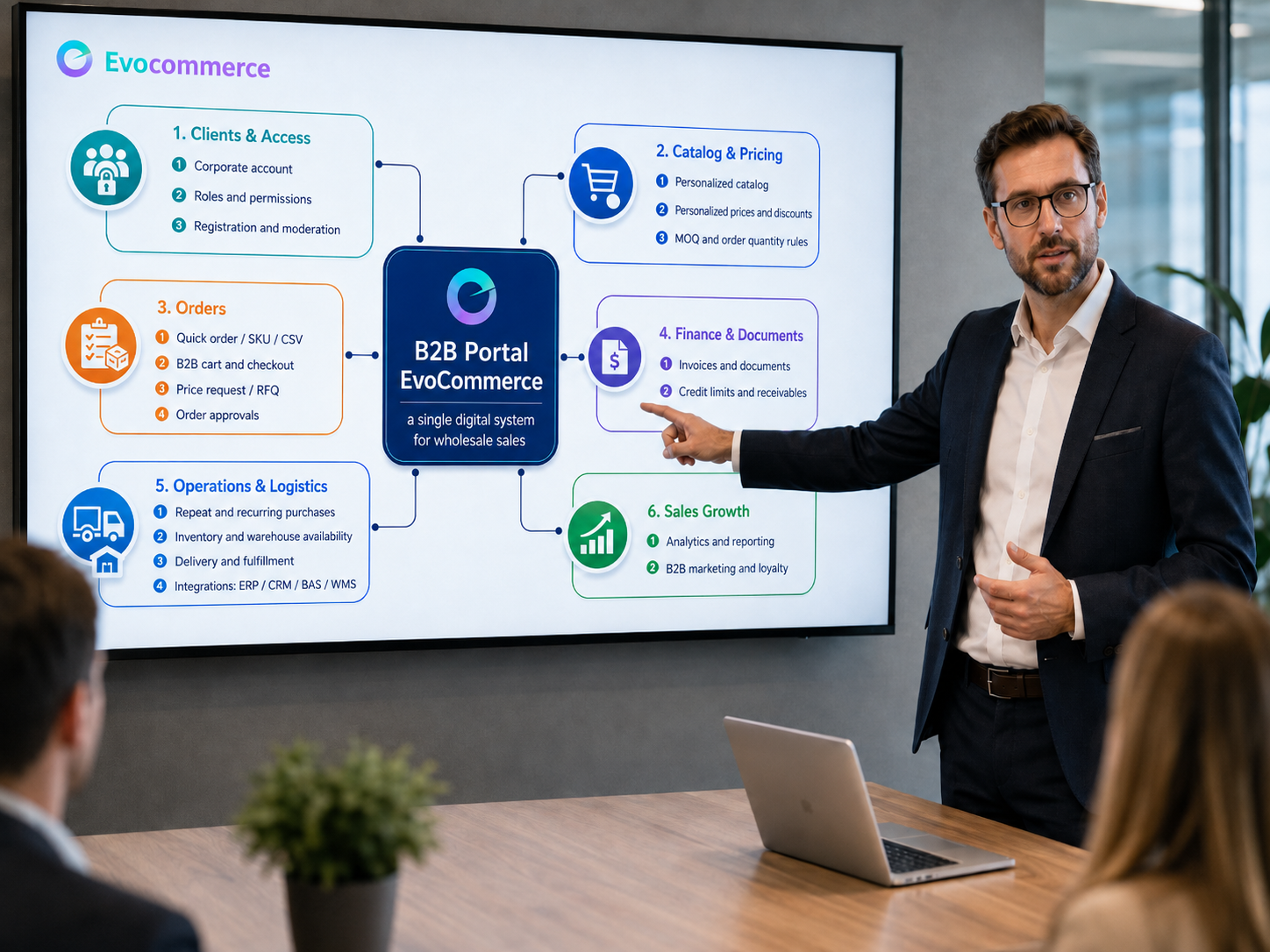
A true B2B portal should not just display products. It should help manage wholesale customers, personalized prices, buyer groups, orders, invoices, documents, balances, delivery, approvals, repeat purchases, manager work, and integrations with accounting systems.
That is why there is a fundamental difference between a simple catalog and a full-fledged B2B portal. The catalog shows the product.The B2B platform Evoсommerce(https://evocommerce.net/b2b/)automates the interaction between the seller and the buyer.
The functional structure of the EvoCommerce B2B portal provides 18 key blocks and up to 200 features for automating wholesale trade: from corporate accounts, roles, and personal catalogs to pricing, approvals, invoices, logistics, integrations, analytics, and B2B marketing.
Why a simple website doesn't solve the problems of wholesale trade
In a typical B2C store, everything is relatively simple: one buyer, one price, cart, payment, and delivery.
In wholesale, everything is more complicated. One client may be a dealer, another a distributor, a third a retail chain, a fourth a regional partner. Each may have different prices, discounts, delivery terms, minimum order amounts, credit limits, contracts, and procurement approval rules.
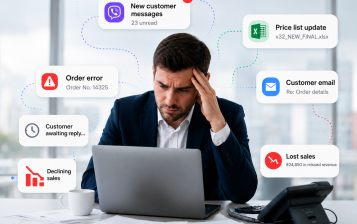
If, after viewing the catalog, the client still has to write to the manager, wait for the price, check the balance, request an invoice, and agree on the terms in the messenger, this means that there is no automation yet.
A full-fledged B2B portal starts with a corporate account
In B2B, the buyer is not just a person. The buyer is a company.
This company can have different users: a purchaser, an accountant, a manager, a director, a financier, a warehouse worker, or a branch manager.
Therefore, the EvoCommerce B2B portal supports the logic of corporate accounts. One account represents a company, and several users with different roles and rights can work within it.
The buyer can create orders. The accountant can view accounts, acts, and invoices. The manager can approve large purchases. The company administrator can add new employees to the office.
This is one of the key differences between a true B2B portal and a simple catalog.
Registration should be part of the sale
Many wholesale companies attract new customers through advertising, Google, social networks or direct contacts. But the process often looks outdated: “Write to Viber”, “We will lower the price”, “The manager will contact you”.
This is not always convenient for a new client. They want to quickly understand what you sell, what conditions you offer, whether you have the right assortment, and whether it is worth working with you.
B2B EvoCommerce provides a better scenario: the client goes to the site, fills out an application, undergoes verification, receives guest or full access, and independently familiarizes himself with the assortment, prices, and terms of cooperation.
Closed registration, account moderation, verification of details, linking to a contract, and activation by client segment turn a random contact into a structured B2B client.
The catalog should be personal, not the same for everyone
In a simple catalog, everyone sees the same assortment. For B2B, this is often wrong.
One client can see the entire catalog. Another - only certain brands. A third - products under contract. A fourth - a separate assortment for their region.
The EvoCommerce B2B platform allows you to create personal catalogs, shared catalogs for customer groups, hidden B2B products, and assortment by contract, brand, direction, region, or sales channel.
It is also important to consider sales units. In retail, goods are sold in pieces, and in wholesale - in boxes, crates, pallets, meters or sets. The client should see exactly the purchasing logic that meets his conditions.
Pricing is the core of a B2B portal
In B2B, there is almost never one price for everyone.
A dealer sees one price. A distributor sees another. A VIP partner sees a third. A customer with a large purchase volume may have a price based on quantity. Another customer has a contract price, fixed by agreement.
Therefore, EvoCommerce B2B supports individual prices for companies, separate price lists, prices by customer group, prices by location, contract prices, discounts by brand or category, prices by quantity, multi-currency price lists, prices with and without VAT.
Hidden prices are especially important. Often, a wholesale company does not want to show purchasing conditions to all site visitors. In this case, prices should be available only after authorization and confirmation of the client.
If prices are calculated manually in Excel, the company risks errors, loss of margin and conflicts with customers. If prices are set up in the B2B portal, the customer sees exactly their terms, and the manager does not waste time on manual calculations.
Minimum and multiple orders should be controlled automatically
Wholesale has its own rules.
You cannot sell one unit if the product is shipped in boxes. You cannot place an order for 3,000 UAH if the minimum amount for a dealer is 10,000 UAH. You cannot sell half a pallet if the product is shipped only in full pallets.
In manual mode, these rules are controlled by a manager. This is time-consuming and creates a risk of errors.
B2B EvoCommerce allows you to set MOQ, minimum order amount, packaging multiples, pallet multiples, maximum limits, and customer type restrictions. The system automatically checks these rules during order processing.
Quick ordering is a critical feature for the wholesale buyer
A wholesale customer often already knows what they are buying. They need to quickly enter the article number, product code, or upload a file with items.
Therefore, the B2B portal should have a quick order. The buyer enters the SKU or name, adds the quantity and forms the order as a list.
EvoCommerce products can use search by article number, code, barcode, manufacturer's catalog number, mass adding of products to the cart, import of orders from Excel or CSV, purchase templates, and repetition of past orders.
This is one of the features that most distinguishes a B2B portal from a regular online store.
B2B checkout must take into account real business conditions
Placing an order in B2B may not be the same as in a regular store.
A customer may have multiple delivery addresses. The invoice may be issued to the head office, and the goods may be delivered to a branch. Some of the goods may be shipped now, some later. Payment may be by invoice, purchase order, deferred payment, or individual terms.
B2B EvoCommerce can support multiple shipping methods, multiple payment methods, payer and recipient selection, multiple addresses, order comments, internal purchase order numbers, scheduled shipments, and draft orders.
It is also important that the manager can place an order on behalf of the client. This is useful when the client calls or writes to the manager and the manager immediately creates the order in the system.
The price request and commercial offer must be within the system
In B2B, the customer often doesn't just buy at the stated price. They can request special terms for large volumes, receive a customized quote, or negotiate the price.
If this happens in email, Viber, or Telegram, the story is quickly lost.
The EvoCommerce B2B platform can support RFQ — request for quote. The client forms a request, the manager prepares a quote, the system records the history of changes, validity period, attached files, price approval, and conversion of the quote into an order.
This moves negotiations from chaotic channels to a controlled system.
Order approval is required for corporate customers
In many companies, a purchase cannot be made by one person without approval.
The buyer creates an order, the department head checks it, the financial director agrees on the budget, and the director approves a large purchase.
Therefore, a full-fledged B2B portal should support approval workflows: approval by amount, product category, department budget, user role, or multiple levels of responsibility.
For the corporate client, it means convenience and control. For the seller, it means fewer canceled, erroneous, or unconfirmed orders.
Finance, accounts, invoices and accounts receivable should be in the office
In B2B, financial processes are more complex than in a regular online store.
The client can work on account, with deferred payment, partial prepayment, credit limit, or various financial terms.
The wholesale buyer's account in B2B EvoCommerce can display bills, invoices, acts, credit notes, payment history, credit limit status, available balance, overdue payments, and financial restrictions.
The system can also block a new order if the customer has overdue debts or has exceeded the credit limit.
Repeat purchases should be made quickly
In wholesale, a large portion of sales are repeat purchases.
The store regularly buys the same products. The dealer places a similar order every month. The service company constantly takes the same consumables.
The EvoCommerce B2B portal can simplify this process: repeating a past order, lists of frequently purchased products, saved carts, regular purchases, reminders, and scheduling orders for a specific date.
The easier it is for a customer to repeat a purchase, the less likely they are to go to another supplier.
Remaining stocks and future deliveries should be transparent
A wholesale customer wants to see not only the product, but also real availability.
How much is in stock? Where exactly is the product? Can I reserve it? When will the next delivery be? Can I order a product that is currently out of stock?
B2B EvoCommerce can show real-time balances, stock balances, available quantity, upcoming deliveries, lead time, reservations, backorders, and partial order confirmations.
This reduces the number of clarifications required by the manager and makes the purchasing process clearer for the client.
B2B logistics must be flexible
Bulk delivery is not always a standard parcel to the branch. It can be pallets, tonnage, self-pickup from the warehouse, delivery on a schedule, multiple addresses, route delivery, partial shipments or warehouse selection.
The B2B portal must support these scenarios. Otherwise, logistics reverts to manual mode.
For large customers, networks, branches and regional partners, this is of great importance. Convenient logistics is often one of the reasons why a customer stays with a supplier for a long time.
Customer self-service reduces the burden on managers
One of the main tasks of a B2B portal is to give the client the opportunity to independently obtain most of the necessary information.
In the account, he should see order history, statuses, documents, invoices, acts, certificates, delivery addresses, users of his company, roles, saved carts, favorite SKUs, commercial offers, and negotiation history.
Then the manager doesn't need to answer the same questions dozens of times: “Where is the invoice?”, “What is the status of the order?”, “What did we buy last time?”, “Reset the act.”
The client receives the necessary information himself. The manager is engaged in sales, not searching for documents.
A B2B portal should help managers, dealers and partners
A full-fledged portal works not only for the customer. It should also be convenient for the sales team.
In B2B EvoCommerce, a manager can place an order on behalf of a client, a sales representative can accept an order during a meeting, and a dealer can see their prices, balances, marketing materials, and special conditions.
Partner offices, territorial binding of managers, a commission model for partners, or separate dealer storefronts for dealers can also be used.
This allows you to develop not only direct B2B sales, but also a partner network.
Integrations turn the portal into part of the business system
Without integrations, a B2B portal quickly becomes another separate resource that needs to be manually maintained.
For automation to be real, the portal must exchange data with ERP, CRM, BAS/1C, WMS, PIM, accounting, warehouse, payment services, delivery services, and purchasing systems of large customers.
The EvoCommerce B2B platform can synchronize products, balances, prices, invoices, payments, credit limits, orders, statuses, and documents.
If the manager still manually transfers data to the accounting system after each order from the portal, the process is only partially automated. Integrations make the portal part of the real business process.
Analytics gives managers control over B2B sales
A B2B portal should not only accept orders, but also provide the manager with information for management.
Which companies buy the most? Which customers haven't placed an order in a long time? Which branches are more active? Which manager works more efficiently? Where is the receivables growing? Which segment has the best margin?
This requires analytics on companies, locations, managers, dealers, repeat purchases, margins, receivables, credit limits, user actions, and order processing speed.
Without analytics, a portal only serves transactions. With analytics, it becomes a sales management tool.
B2B marketing helps increase repeat sales
A B2B portal can be not only an order office, but also a marketing channel.
In B2B EvoCommerce, you can use personal promotions for companies, promotions for dealers, offers by brand or category, bonuses for purchase volume, personal recommendations, related products, reactivation offers for inactive customers, and special banners for individual corporate accounts.
This is important because B2B sales are not just about the first order. It's about working with the client for a long time, making repeat purchases, developing the average check, and increasing loyalty.
How many features do you actually need?
Not every company needs all 200 capabilities at once. It depends on the scale of the business, the number of customers, the complexity of pricing, the number of warehouses, integrations, and the sales model.
But there is a basic set, without which it is difficult to consider a B2B portal complete: corporate accounts, user roles, customer moderation, personal catalogs, personal prices, minimum and multiple orders, quick order, B2B checkout, order history, documents, statuses, repeat purchases, balances, integration with accounting, client account, manager work on behalf of the client, and basic analytics.
For more complex businesses, quotes, approvals, credit limits, accounts receivable, future deliveries, multiple warehouses, regular orders, partner accounts, API, ERP/CRM/WMS integrations, and B2B marketing are added.
How to understand that your company already needs a B2B portal
A company should consider a B2B portal if managers are constantly sending price lists, customers are confused about prices, orders come in via Viber, Telegram, Excel, or email, the same questions are repeated every day, invoices and documents have to be searched manually, customers often check balances, and the manager does not see the full picture of B2B sales.
A B2B portal is also needed if the company wants to actively attract new wholesale customers. A new buyer should not just receive a PDF price list, but log in to a clear account, see the assortment, access their terms and conditions, and take the first step towards ordering.
To summarize
A simple website, catalog, or price list does not automate wholesale. They only partially transfer the assortment online.
The Evoсommerce B2B portal works differently.It takes into account company structure, user roles, personal catalogs, individual prices, minimum orders, fast processing, commercial offers, approvals, invoices, documents, credit limits, balances, delivery, repeat purchases, integrations, analytics, and B2B marketing.
It is this system that allows a wholesale company to work faster, reduce manual work, avoid losing orders, attract new customers, better serve partners, and develop its own brand.
B2B Evoсommerce is not a “simple catalog.” It is a digital infrastructure for wholesale trade that helps businesses manage sales, customers, prices, orders, and partner network development in one system.
You may also like it